Rationale:
At St Peter’s we have designed a curriculum that best serves the needs of OUR learners, is enriching, non-limiting and broadens pupils’ horizons. A well-constructed, broad and rich curriculum allowing pupils to make sense of the world around them, leading them towards exam success. The curriculum is cumulative and interleaved so this means all learners will study the same texts in each year that references can be made back to the things they have studied previously. We want all of our pupils to develop a love and passion for reading through reading a wide range of fiction and non-fiction, in particular whole books. With this in mind, we have selected texts that have literary merit to add to pupils’ ‘cultural capital’ which is at the heart of our curriculum. Our chosen texts also promote a critical appreciation of the ‘canon’ whilst also serving to introduce pupils to writers from a range of cultural backgrounds.
We have designed a spiral curriculum, where knowledge and application is revisited and built upon each year to enhance progress for our pupils. By interleaving our curriculum content it enables us to support the embedding and retention of knowledge. Knowledge and skill are intrinsically linked: skill is a performance built on a person’s knowledge. We want out teachers to demonstrate deep knowledge and understanding of English Language and English Literature in the classroom. Pupils’ acquisition and command of vocabulary are key to their learning and progress across the curriculum. They will be taught how to make links between known and new vocabulary in order to develop their vocabulary acquisition, as we believe this is fundamental to gaining academic success.
Finally, we also want to promote the love and passion for English by ensuring our pupils have lots of enrichment opportunities. We have a range of activities such as a Trust Wide Spelling Bee, Poetry by Heart and a Debate Club, which our schemes of learning embed skills and knowledge to equip our pupils to be successful in these enrichment activities. We believe these activities also give our pupils opportunities to speak publicly in front of large audiences to help develop their speaking, listening and confidence.
Intent:
We aim to create the very best communicators, readers, writers and thinkers. The functions of literature and language is to enable pupils to lead the best possible lives, which we believe is at the forefront of our curriculum. Through English Language, we seek to provide pupils with the language capacity to navigate and succeed in courses of their own choosing, as well as inspiring those pupils who wish to pursue more language-based careers, such as writing, journalism, education. Through English Literature we seek to develop pupils’ ability to think deeply about humanity, and to discover the riches of their Literary Heritage and local area, whilst developing the critical faculties to evaluate the ideas and the craft in these texts. We challenge pupils to think, act and speak like those working in the field would: to read like writers, to write like readers, to speak like orators.
Our curriculum at St Peter’s goes far beyond what is taught in lessons, for whilst we want pupils to achieve the very best examination results possible, we believe our curriculum goes beyond what is examinable. We do this by regular exposure to a wide range of the finest fiction and non-fiction texts, exploring them through practical, creative and analytical approaches. We invest in spoken language skills. We offer extra-curricular clubs in poetry writing, film club, the school news report and debating. We support productions by exposing our pupils to theatre productions and poetry events and work with writers both in and out of school. Participation in local and national competitions is also supported and we have had pupils shortlisted for the Worlds at Home, a Trust Writing Anthology and the Northern Young Writers Award. This year we will be encouraging our pupils to enter further writing competitions, attend Poetry by Heart competitions as well as The Spelling Bee.
Our curriculum in English forms a backbone to our ethos statement. Examples of how our curriculum supports the ethos statement are the range of activities that demand pupils to think inquiringly and independently, developing their ability to articulate ideas confidently, thoughtfully, and with precision, politeness and accuracy, and to listen to, evaluate and respond to the opinions of others. Enthusiasm is modelled by our staff and praised in our pupils who are engaged and motivated to do well. As a knowledge-engaged curriculum we believe that knowledge underpins and enables the application of skills; both are entwined. As a department we define the powerful knowledge our pupils need and help them recall it by having a carefully planned progression through our curriculum with content and skills clearly defined in our schemes of work which have a regular focus on learned content. We have also incorporated and embedded a range of conceptual threads, which have visual icons that will be evident in PowerPoints and all of our resources so pupils can quickly make thematic links with the topics and understand how they are building upon their knowledge. To support our pupils’ study, we have bespoke core knowledge organisers to accompany units so that pupils can refer to their core knowledge throughout the year. Pupils have access to the content they need through Google Classroom – and are informed about other resources they can access.
We build the Cultural Capital of our pupils constantly by teaching texts in context. We ensure that the curriculum covers both key writers in the traditional canon, and examples of literature and language from a range of times, cultures and traditions. We make clear how language and literature have been and can be instrumental in changing the world we live in through our literature timeline. We encourage wider reading and the exploration of related texts through year group reading lists, which are shared on Google Classroom and Social Media platforms. Further rationale behind our curriculum design includes building on the knowledge acquired at KS2, and to develop the ability to read perceptively, and write and speak expressively and persuasively. We make clear the links between language and literature and well-being. We ensure the level of challenge is high with support for pupils who need it. We have also made some cross-curricular links, such as Art will now teach ‘Cultural masks’ at the same time as we teach ‘Poetry from Different Cultures’.
Implementation:
We have a thematic approach to our curriculum, which is designed to help our pupils become the best communicators, readers, writers and thinkers.
In Year 7 our topic is: ‘Identity and your place in the world’.
Over the course of Year 7, pupils will study a range of texts to help them explore the identity of a range of influential writers or characters from the world and also local areas to help them uncover their own identities and where they fit in this world. Pupils will begin their journey at St Peter’s by spending a full term with the text ‘The Bone Sparrow’. We believe it is crucial to spend this length of time on a full text to encourage our pupils to engage with full texts.
Pupils will then explore a selection of Greek mythology in the first half of spring term, as well as some local legends so they can discover the impact on the area they live in. Studying Greek mythology in Year 7 will help build the foundations to later texts in their study such as their GCSE text: ‘Romeo and Juliet’, where they can make links to the fates.
Pupils will then study a Shakespeare text: ‘Much Ado About Nothing’, which again is crucial at this time as they will begin to explore Shakespeare’s context, in particular the Elizabethan era and patriarchy, which again will link to other texts studied further in their curriculum.
In the summer term, pupils will explore poetry of the natural world. Here they will explore the Romantic Movement and how romantic writers were influential with their poetry. This will be fundamental to their study when they look at Gothic Literature in Y8 and later poetry from the power and conflict anthology at GCSE.
Year 7 will end with Treasure Island, where pupils will be introduced to Victorian society and how this novel provided an escapism from industrialisation. Pupils will also be given the opportunity to make links to their local pirate and smugglers heritage through non-fiction extracts and learn the conventions of writing to inform.
In Year 8 our topic is: ‘Injustice and inequality in the world’.
Over the course of Year 8, pupils will study a range of texts that will be from unfamiliar contexts to help them discover the injustices influential writers felt passionate to write about to help pupils discover more about the world around them. In the autumn term, pupils would be reading and studying: ‘The Hunger Games’ a dystopian novel about the social injustices faced by different district members.
In the Spring term, pupils will discover and explore poetry from different cultures, which will encourage enjoyment and empathy for a range of cultures. The knowledge and skills taught in this unit will enable pupils to make links with the poetry anthology unit at GCSE.
Next pupils will study another Shakespeare play, which will be Macbeth. Pupils will be able to build on their knowledge of patriarchy and in particular the role of women. They will be able to explore in depths the role of Lady Macbeth and how she contradicts the ideal woman at the time, as well as other contextual links such as witches, genocide and the divine right. The study of Macbeth will make a natural transition into the study of gothic literature and then the play: Frankenstein. Pupils will be able to study how the gothic, through an anthology of texts, emerged from the Romantic Movement (which they studied in Year 7) to become popular during the Victorian period.
In Year 9 our topic is: ‘Using your voice to make a difference in the world’.
Over the course of Year 9, pupils will be given opportunities to explore a range of texts and influential writers to enable them to feel empowered to use their own voices to make an impact on the world around them. They will begin their study in the autumn term exploring a text ‘Curious Incident of the Dog in the Nighttime’ that highlights how members of society think differently. They will then move onto an introduction of Dickens, where they will develop their understanding of Victorian context from their study in Year 7 (Treasure Island) and Y8 (Gothic Literature) so pupils can begin to understand how Dickens’ writing is so influential, in particular, ‘A Christmas Carol’ which will be studied at GCSE.
In the spring term, pupils will move onto an introduction of: ‘An Inspector Calls’, where there will be extracts from: ‘Things a bright girl can do’ interwoven through the scheme so pupils can explore and understand the Suffragette movement and how this impacted women at the time. This will then lead into Edwardian society and how Priestley was influenced to write his play: ‘An Inspector Calls’, which will be one of the GCSE texts studied. Pupils will then explore how to use their voice, using Greta Thunberg and a collection of influential speeches from: ‘No one is too small to make a difference’. This will equip our pupils with the necessary skills to develop a mature voice and practise writing a range of persuasive and provocative pieces of texts, which will prepare them for Paper 2, section B at GCSE.
In the summer term, students will be introduced to the play: ‘Romeo and Juliet’ and become familiar with context, plot, characters and themes.They will develop their understanding of Elizabethan society and patriarchal society.Finally, they will read a range of poems, which explore the themes of love and relationships.
In Year 10 pupils will begin their GCSE study.
Year 10 will begin their GCSE study by exploring a selection of fiction extracts to help recap the analytical skills and using the PEEL structure, which are crucial skills needed to help them succeed in their GCSE study. There will also be opportunities in the classroom for class discussions to help enrich pupils and support them to regain their confidence in the classroom.
Pupils will then study their GCSE Literature texts: Power and Conflict Poetry, Romeo and Juliet, A Christmas Carol and An Inspector Calls. Years 7-9 will have built the foundations for these texts through their study of context for various literature texts and time periods that contribute to the literature timeline. Studying the literature texts in Y10 will also alleviate the pressure in Year 11 and give them enough time to prepare and practise exam questions in preparation for their GCSEs.
Impact:
We will know our curriculum is working in the English department through the engagement of pupils both observed and recorded in pupil voice across the academy. The quality of teaching and learning in English has been praised during learning walks by both external and internal observers. High stakes assessment will consist of the cumulative assessments built into the scheme of learning and assessment points. Low stakes assessment will consist of peer and self-assessment within lessons, verbal questioning, small quizzes and all other methods of assessment for learning.
Staff are expected to follow the feedback and marking policy. Additional checking of pupil work should take place for any pupils where there are concerns about pupil progress and the three groups identified below are most likely to require this.
1) Disadvantaged/Pupil Premium Pupils
2) Pupils with identified SEN or other needs
3) Pupils who are currently not making expected levels of progress in the subject.
We will see examination results improved over time and begin to be in line with national average or above national average, as well as contributions by English making a real impact on the academy P8 score.
More importantly, pupils frequently express their enjoyment of the subject and their appreciation of what they have gained from English that they can take out into the world. A significant number of pupils will have the opportunity to go onto College and then University from their English pathway; many choosing to do English Literature or a related degree such as speech therapy and creative writing. Skills acquired in English also support a range of other degree courses – especially law, psychology, criminology, Classics and other arts degrees.
Year 11 English Curriculum:
Intent:
The curriculum is planned to interleave language and literature so pupils are constantly re-taught and revising core knowledge for their literature texts and the skills needed to ensure they are successful in their language papers. In language there will be significant time spent on section B of each paper to teach pupils a methodical approach and structure to gain success with the golden paragraph structure for language paper 1 and the writing toolkit for paper 2, as these sections are worth 40 marks and half of the exam paper. Through the teaching of literature texts, fiction and non-fiction texts pupils will have lots of opportunities to analyse texts and embed the PEEL structure to gain exam success. They will be provided with banks of key quotations to revise for their literature texts and have opportunities in lessons and through homework tasks to complete extended responses on exam questions. In order to fully prepare pupils for their literature exams they will also be taught a methodical approach, where they will have pre-prepared revised grade 9 introductions so that they have something to write as soon as their exam time starts. The curriculum aims to continually challenge all pupils, by pitching each topic to the ability of individual pupils’ needs, including those of lower ability and those of higher ability.
Implementation:
Year 11 pupils will begin their final year by studying language paper 2, which will also interleave the literature texts: Romeo & Juliet and A Christmas Carol. Pupils will sit their first PPE in the beginning of November. These results will then inform further intervention sessions, as well as follow up lessons. A range of engaging texts have been selected and grouped by themes to hook our pupils for example: ‘women in literature’ and ‘black lives matter’ to provoke and encourage discussion in the classroom and to help build confidence of pupils. After their PPE’s, pupils will then revise language paper 1 skills, which will be interleaved with An Inspector Calls and Unseen Poetry. Pupils will then sit another PPE in March. After the second PPE there will then be the opportunity for staff to adapt the curriculum to the needs of their pupils, ensuring there is a personalised curriculum for their teaching group. The recall tasks are strategically planned to ensure that topics are suitably interleaved, as well as repeated to give pupils the chance to practise skills to ensure they ‘can’t get it wrong’.
Impact:
Pupils will complete two sets of PPEs in Year 11, but amongst that will be exam practice and exam focus in every lesson. Included in the curriculum is a range of interventions to support the pupil’s learning. This includes form time intervention, before and after school intervention and small group tutoring. This is informed by the QLA from assessments that pupils are sitting in class and from their PPE results.
English Language Assessment Objectives:
AO1 • Identify and interpret explicit and implicit information and ideas • Select and synthesise evidence from different texts
AO2 • Explain, comment on analyse how writers use language and structure to achieve effects and influence readers, using relevant subject terminology to support their views
AO3 • Compare writers’ ideas and perspectives, as well as how these are conveyed, across two or more texts
AO4 • Evaluate texts critically and support this with appropriate textual references
AO5 • Communicate clearly, effectively, and imaginatively, selecting and adapting tone, style and register for different forms, purposes and audiences • Organise information and ideas, using structural and grammatical features to support coherence and cohesion of texts
AO6 • Candidates must use a range of vocabulary and sentence structures for clarity, purpose and effect, with accurate spelling and punctuation. (This requirement must constitute 20% of the marks for each specification as a whole.)
AO7 • Demonstrate presentation skills in a formal setting
AO8 • Listen and respond appropriately to spoken language, including to questions and feedback to presentations
AO9 • Use spoken Standard English effectively in speeches and presentations
English Literature Assessment Objectives
AO1: Read, understand and respond to texts. Students should be able to:
- maintain a critical style and develop an informed personal response
- use textual references, including quotations, to support and illustrate interpretations.
AO2: Analyse the language, form and structure used by a writer to create meanings and effects, using relevant subject terminology where appropriate.
AO3: Show understanding of the relationships between texts and the contexts in which they were written.
AO4: Use a range of vocabulary and sentence structures for clarity, purpose and effect, with accurate spelling and punctuation.
English Enrichment:
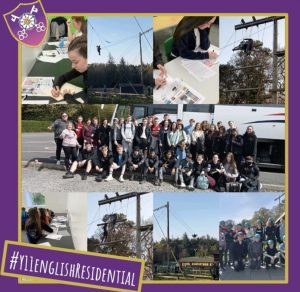 Y11 English ResidentialY11 took part in intensive English residential at Dukeshouse Wood, working hard perfecting their English skills until 8pm! Activities included facing their fears on Jacob’s Ladder; Competing against one another across an obstacle course; and, reaching new heights on the 3G Swing. But it definitely wasn’t an experience of all play and no work, as pupils completed intensive revision focusing on English Language Paper 2 to address any misconceptions and build on their analytical skills, as well as powerfully improving on writing from a viewpoint. Lots of fun and hard work.. Y11 English ResidentialY11 took part in intensive English residential at Dukeshouse Wood, working hard perfecting their English skills until 8pm! Activities included facing their fears on Jacob’s Ladder; Competing against one another across an obstacle course; and, reaching new heights on the 3G Swing. But it definitely wasn’t an experience of all play and no work, as pupils completed intensive revision focusing on English Language Paper 2 to address any misconceptions and build on their analytical skills, as well as powerfully improving on writing from a viewpoint. Lots of fun and hard work.. |
|
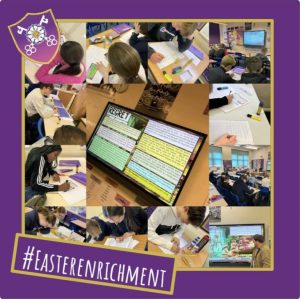 Easter Enrichment
Pupils were working hard on their literature papers – planning exam responses and exploring extract questions on ‘Romeo and Juliet’, ‘A Christmas Carol’ and ‘An Inspector Calls’. Well done to all that attended!
|
|
|
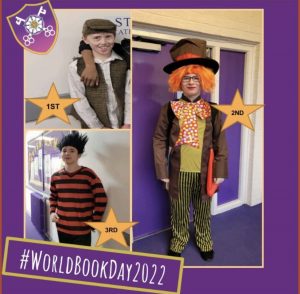
Each year we celebrate in style by wearing costumes of characters from our favourite books. We also hold our annual ‘Great British Literature Bake Off’ with a wonderful selection of delicious home bakes. A huge well done to everyone, with all staff and year groups taking part!
|
|
|
|
|
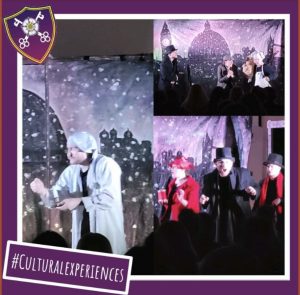 Cultural Experiences
‘A Christmas Carol’ – Y10 enjoyed a theatre experience with a performance of ‘A Christmas Carol’ thanks to the English Department and Quantum Theatre. Pupils were able to track Ebenezer Scrooge’s journey of redemption from a ‘solitary oyster’ to a benevolent ‘second father’!
|
|
|
|
|
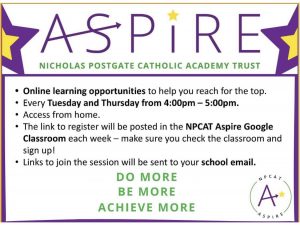
Aspire
After its success last year, Y10 and 11 will be able to access weekly online tuition from Trust Subject Leaders with the aim to support and challenge pupils in English, as well as other subjects. Watch this space! |
|
|
|
|
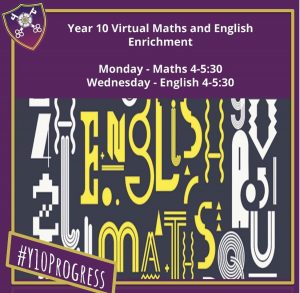 Y10 Virtual English Enrichment – Wednesdays 4pm-5:30pm
After its success last year, Y10 will be able to access weekly online tuition from class teachers with the aim to support and challenge pupils in English. Watch this space!
|
|
|
|
|
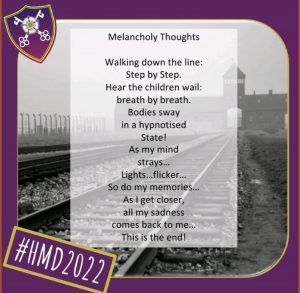 Holocaust Memorial Day 2022
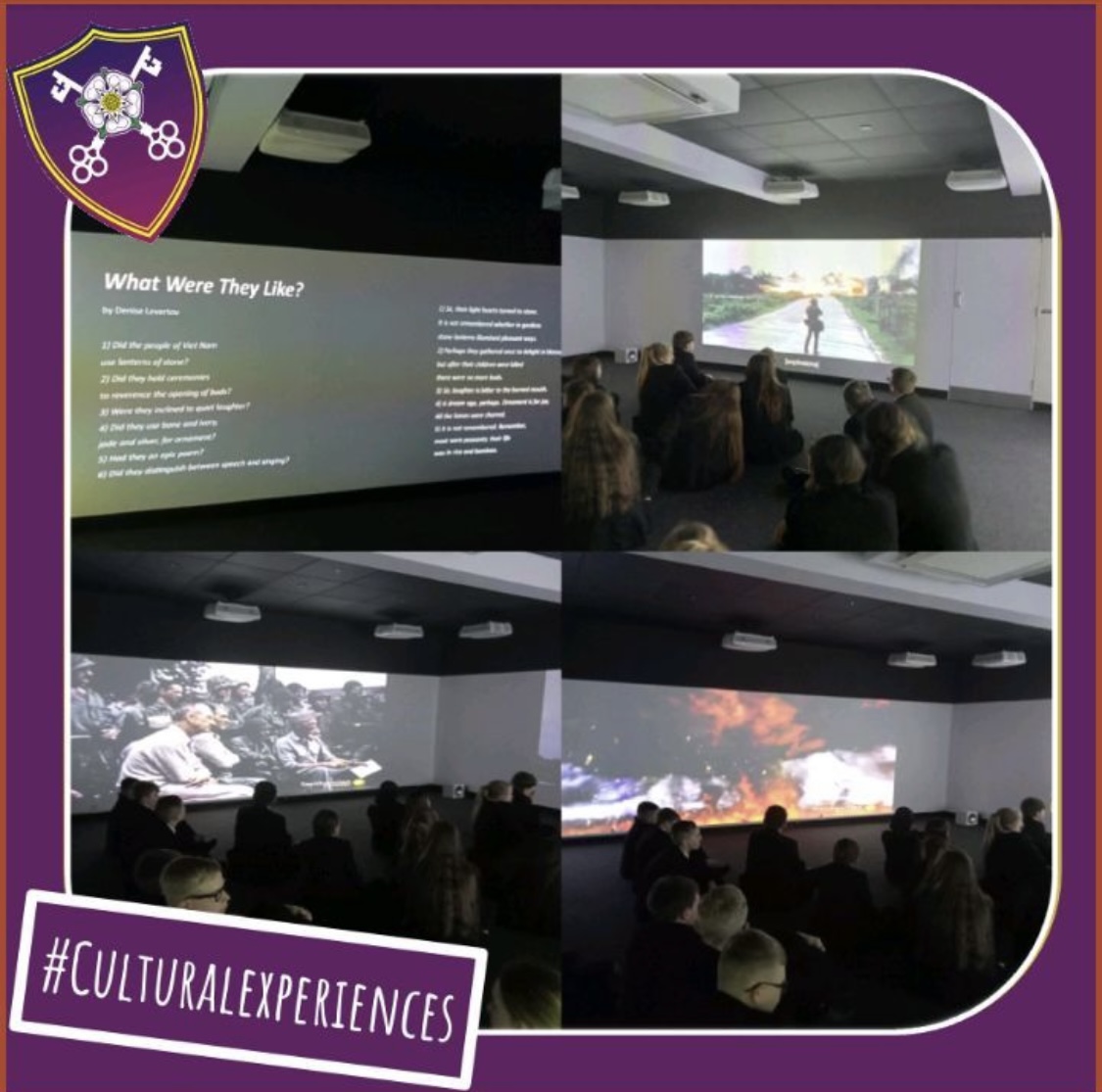
Two talented Y10 pupils wanted to write their own poetry for the people who lost their lives during the Holocaust. They wanted to pay tribute to them and let them know they would never be forgotten. This was a result of our pupils visiting our virtual reality suite to learn about the importance of Holocaust Memorial Day.
|
|
|
|
|
 Saturday Intervention
As exam season approaches, the English department will be leading Saturday intervention sessions running from 10-12pm. This will be a targeted intervention to support and challenge our pupils with specific language and literature topics that they need to know for their upcoming GCSE exams. Watch this space! |
|
|
|
|
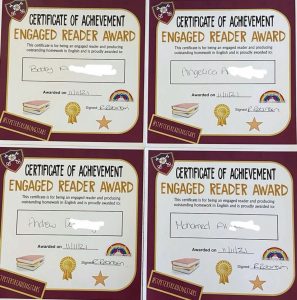 Engaged Reader Awards
Miss Robinson has been awarding pupils with the ‘Engaged Reader Award’ for making so much progress with their reading in English lessons to encourage a love of reading and emphasise how fundamentally important it is to be successful in life!
|
|
|
|
|
|
Y8 pupils were able to experience the Vietnam culture in the virtual reality suite and how the Vietnam War affected that culture. This learning was beneficial to their English study of the protest poem: ‘What Were They Like?’. |
|
 World Book Day
 Virtual Reality